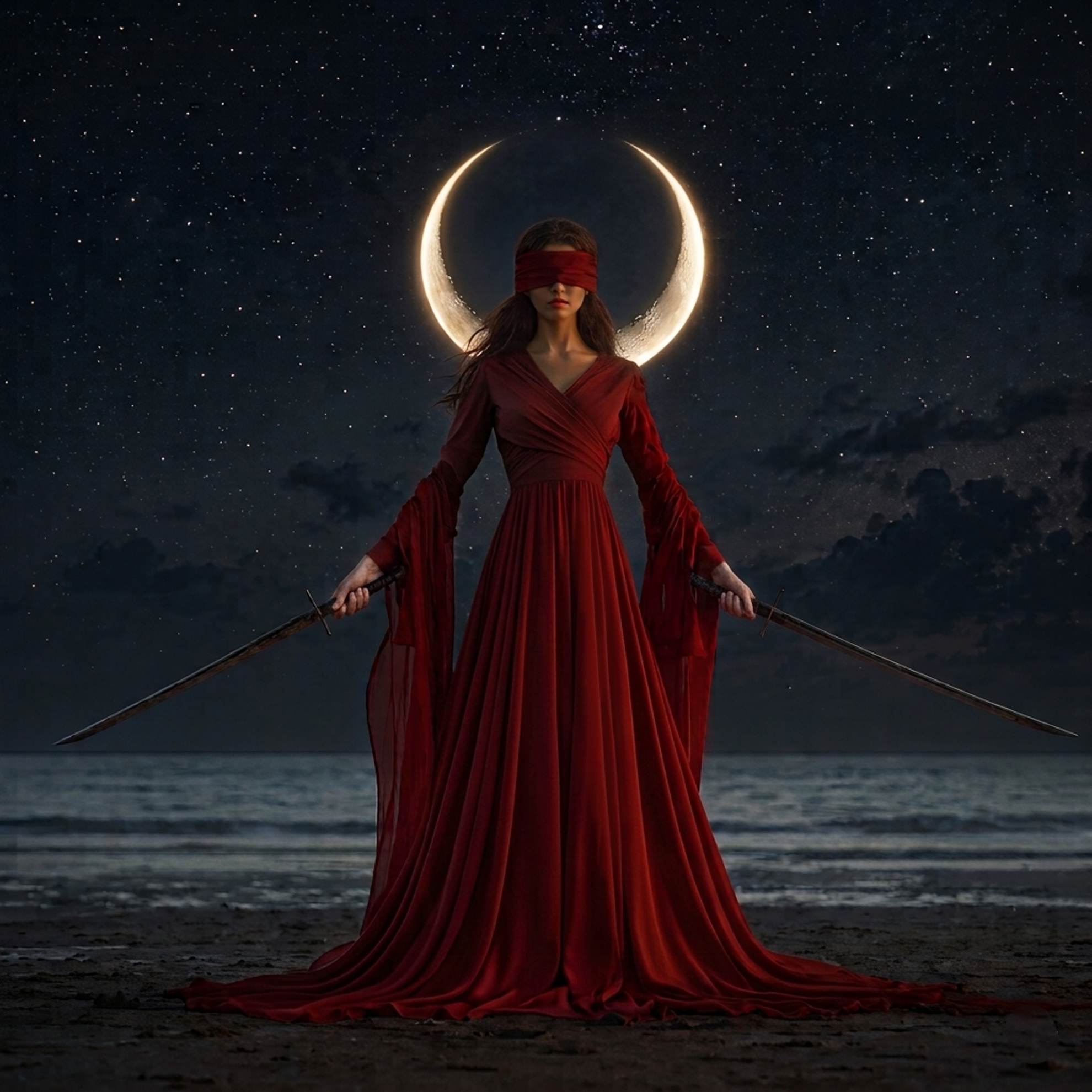
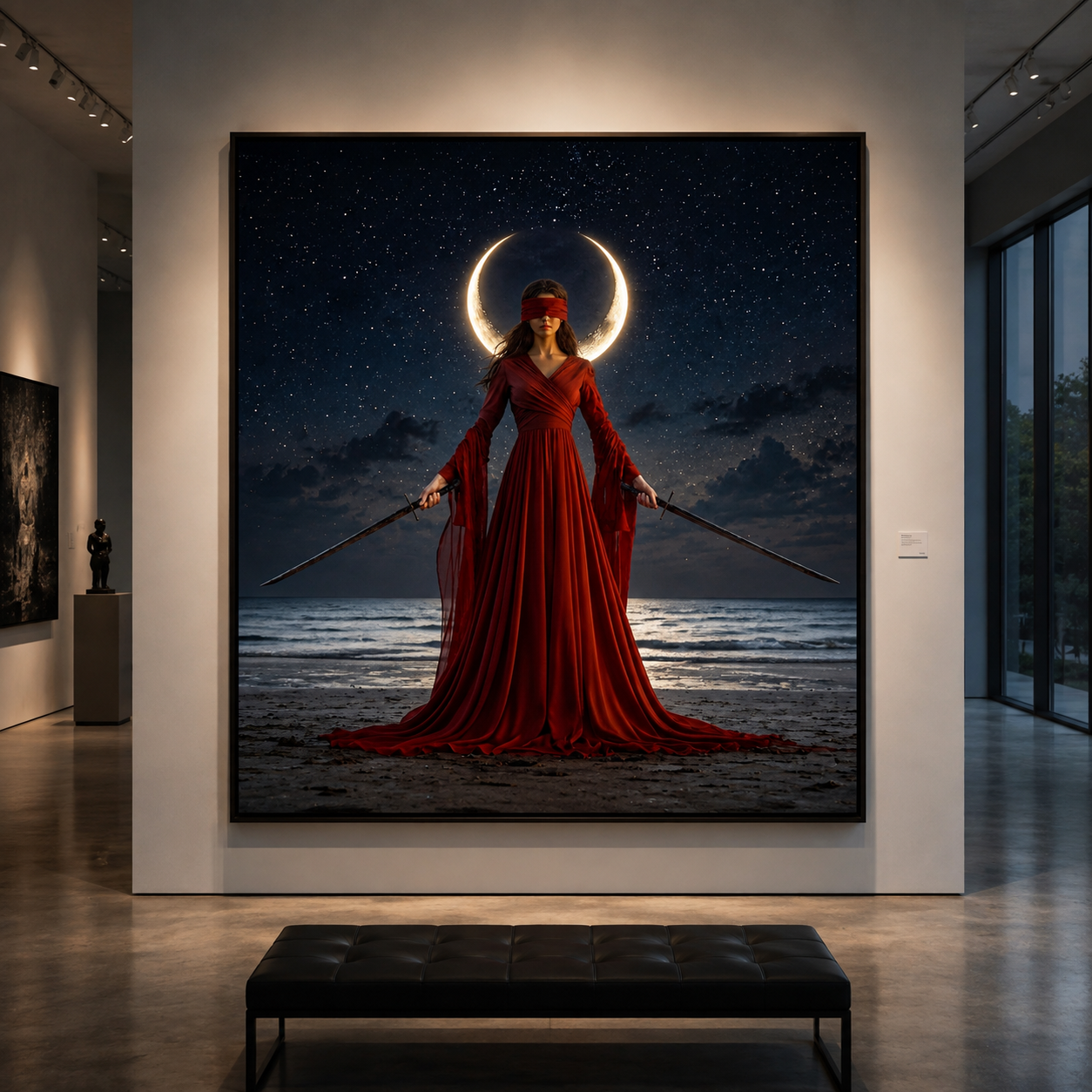
The Oracle explores the moment when certainty falls away and a woman is forced to trust the one thing that cannot be proven to anyone else—her own inner knowing.
The blindfold is central to the work. It does not represent helplessness or ignorance, but the deliberate removal of external sight. She cannot rely on appearances, reassurance, or what others tell her is true. She must move inward. In that darkness, intuition becomes its own form of vision.
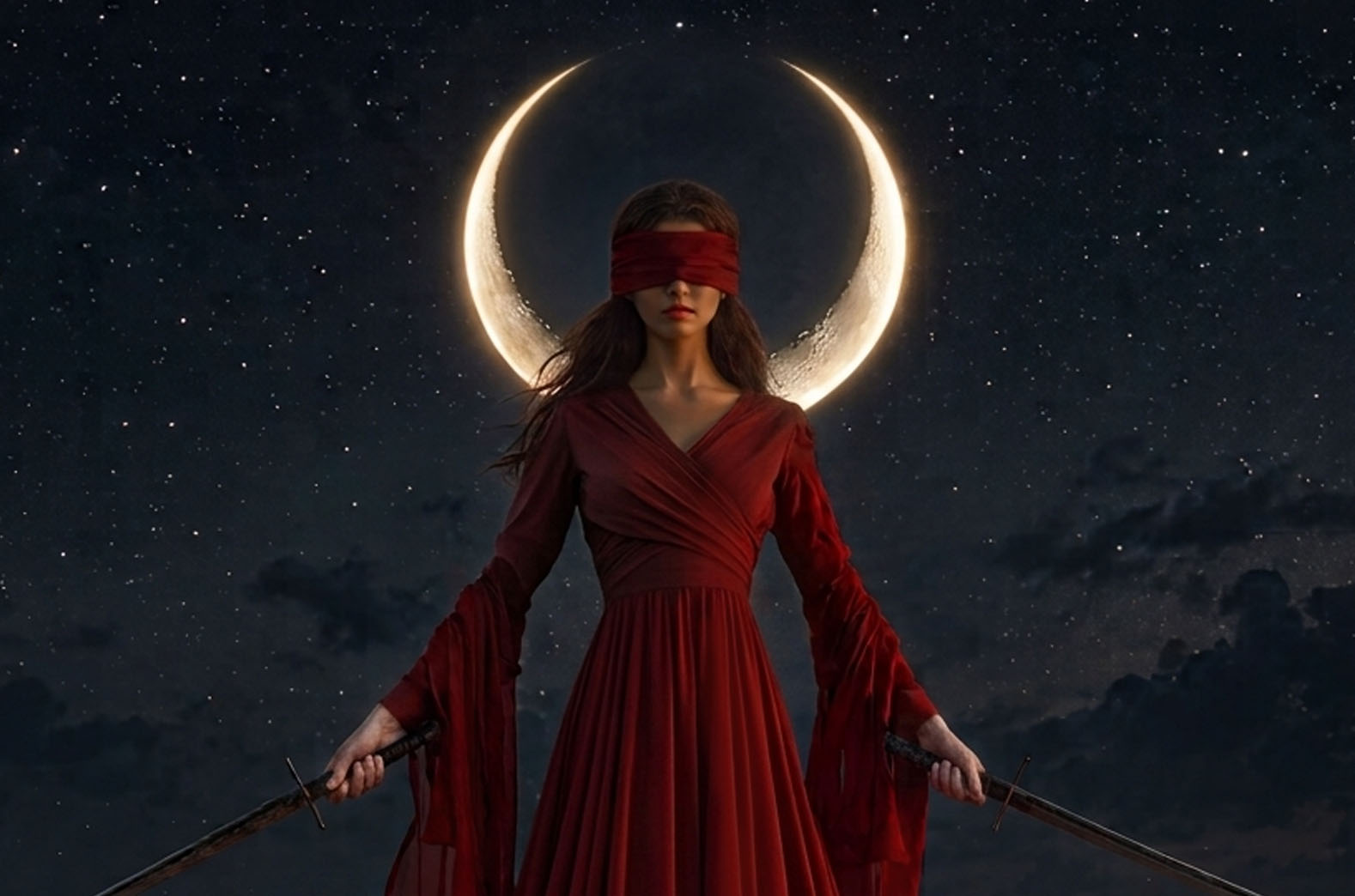
Behind her, the crescent moon forms a luminous halo. The moon symbolizes feminine intuition, cycles, transformation, and the unseen forces that continue to shape us even when they cannot be fully understood. Its placement around her head suggests that wisdom is not coming from the outside world; it is rising from within her own consciousness.
The two swords represent discernment. They are not raised in aggression, but held at her sides with control. One can be read as the ability to recognize truth; the other, the strength to act upon it. Together they symbolize boundaries, self-protection, clarity, and the difficult understanding that intuition without discernment can leave us vulnerable, while discernment without intuition can leave us disconnected from ourselves.
The crimson gown brings another layer of meaning. Red carries associations with life force, passion, courage, blood, desire, and survival. Against the darkness of the night, it becomes almost impossible to ignore. She is not disappearing into uncertainty. She stands visibly within it. The color suggests that although she cannot see what lies ahead, she is fully alive inside the experience.
The night sky represents the unknown—the vast territory beyond what can be controlled or logically predicted. Stars remain visible within that darkness, suggesting that guidance does not always arrive as a clear answer. Sometimes it appears as fragments: instinct, synchronicity, a feeling in the body, or a quiet awareness that something is either aligned or wrong long before the rational mind understands why.
The ocean deepens that symbolism. Like intuition, the sea is constantly moving beneath the surface. It represents the subconscious and the emotional world—the part of the self that stores memory, instinct, fear, longing, and truths that have not yet reached conscious awareness. She stands at its edge, positioned between what she knows intellectually and what she senses beneath it.
There is a deliberate contradiction within the figure: she is blindfolded, yet armed; surrounded by darkness, yet illuminated; standing before an unpredictable sea, yet completely still.
That tension is the heart of The Oracle.
The work considers the kind of strength that develops when a woman stops requiring external confirmation before trusting what she already knows. It is about recognizing that intuition is not the absence of reason, but another form of intelligence—one shaped by experience, pattern, memory, and perception that may register truth before language can explain it.
The Oracle does not promise that inner knowing will make the path easy. The swords acknowledge that truth can require boundaries. The blindfold acknowledges that clarity may come without certainty. The moon acknowledges that understanding unfolds in cycles rather than all at once.
She does not know everything.
She simply knows enough to trust herself.
And that becomes her power.
Receive exhibition announcements, new work releases, studio updates, and private previews from Lisa Bayer.