
Threshold of the Self explores the moment when we become aware that the life, identity, or version of ourselves we have known is no longer the only one available to us.
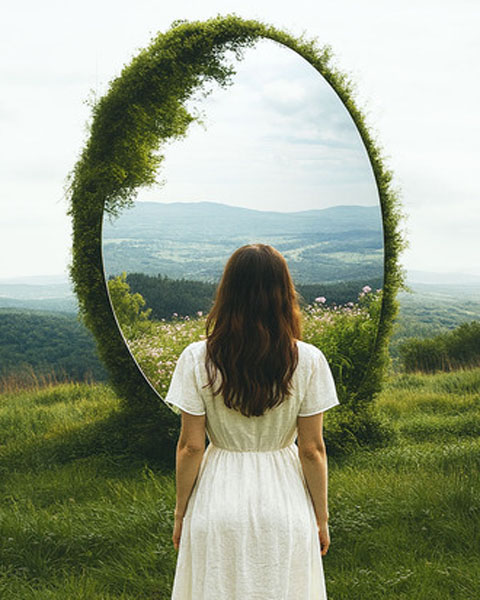
A solitary woman stands before an oval passage covered in living moss and greenery, facing an opening into a landscape that feels both familiar and slightly beyond reach. The threshold is not presented as an escape from one world into another, but as a psychological and spiritual boundary—the space between who we have been and who we are becoming.
The portal represents that point of inner recognition when change becomes visible before it has fully been chosen. It is the moment when we can sense another way of living, another expression of ourselves, but crossing into it still requires intention. The opening does not pull her through. She must decide whether she is willing to move toward it.
Its oval shape carries its own symbolism. Unlike a rigid doorway built by human hands, it feels organic and almost womb-like—a form associated with cycles, birth, return, and renewal. It suggests that transformation is not always about constructing an entirely new self. Sometimes it is a process of returning to something more original beneath the layers we have accumulated.
The moss and vegetation growing over the portal represent time, healing, and the intelligence of nature. Moss develops slowly. It forms where conditions allow life to quietly take hold, often covering surfaces that once seemed hard or permanent. Here, it becomes a symbol of the way the self can soften and regenerate over time. What once felt fixed can be reclaimed by growth.
The woman stands with her back to the viewer, leaving her expression unknown. That anonymity allows her to become less of a specific individual and more of a reflection of the viewer. We cannot see whether she is afraid, hopeful, uncertain, or ready. We are left at the threshold with her.
Her white dress introduces a sense of simplicity and emotional openness. White can suggest innocence, clarity, surrender, and beginnings, but here it also strips away distraction. She carries no visible armor, status, or identity markers into the passage. What remains is simply the person herself.
The landscape surrounding her is already beautiful, which is important. She is not standing in devastation trying to flee it. The work is about a more subtle form of transformation: recognizing that we can outgrow even places, identities, and patterns that once felt safe.
Beyond the threshold lies another expansive landscape—green, open, and seemingly continuous with the world she already inhabits. That visual similarity suggests that transformation may not always change the external world dramatically. Sometimes the landscape remains the same while the person who enters it has changed.t
The distant hills symbolize possibility without certainty. They cannot be fully reached or understood from where she stands. She can only see enough to know that something exists beyond the boundary.
The wildflowers and open field reinforce the idea of becoming through natural growth rather than force. Nothing in the scene appears hurried. There is no command to cross. The work allows for the quiet period before action—the internal pause when we recognize that a former identity no longer fits but have not yet completely stepped into the next one.
At its heart, Threshold of the Self is about the courage required to meet the person we might become without already knowing her.
The threshold is not simply between two landscapes.
It is between the self formed by history, expectation, fear, and familiarity—and the self waiting beyond those boundaries.
And sometimes the most significant transformation begins before we ever take the first step.
It begins the moment we realize the doorway is there.


Receive exhibition announcements, new work releases, studio updates, and private previews from Lisa Bayer.